
Open the EMI Breakup Calculator →
EMI Breakup Calculator India: See Exactly Where Every Rupee of Your EMI Actually Goes
A few years back, I checked my home loan statement after paying EMIs faithfully for two years. I expected my outstanding balance to have dropped by a decent chunk. It had barely moved. I remember genuinely double-checking with my bank, thinking there was some error on their end. There wasn’t. That’s just how EMIs work in the early years, and nobody had ever really explained it to me.
If you’ve felt that same confusion, this page is for you. An EMI breakup calculator shows you exactly what I wish someone had shown me back then, how much of every single payment is interest, and how much is actually principal, month by month, for the entire life of your loan.
The Calculator
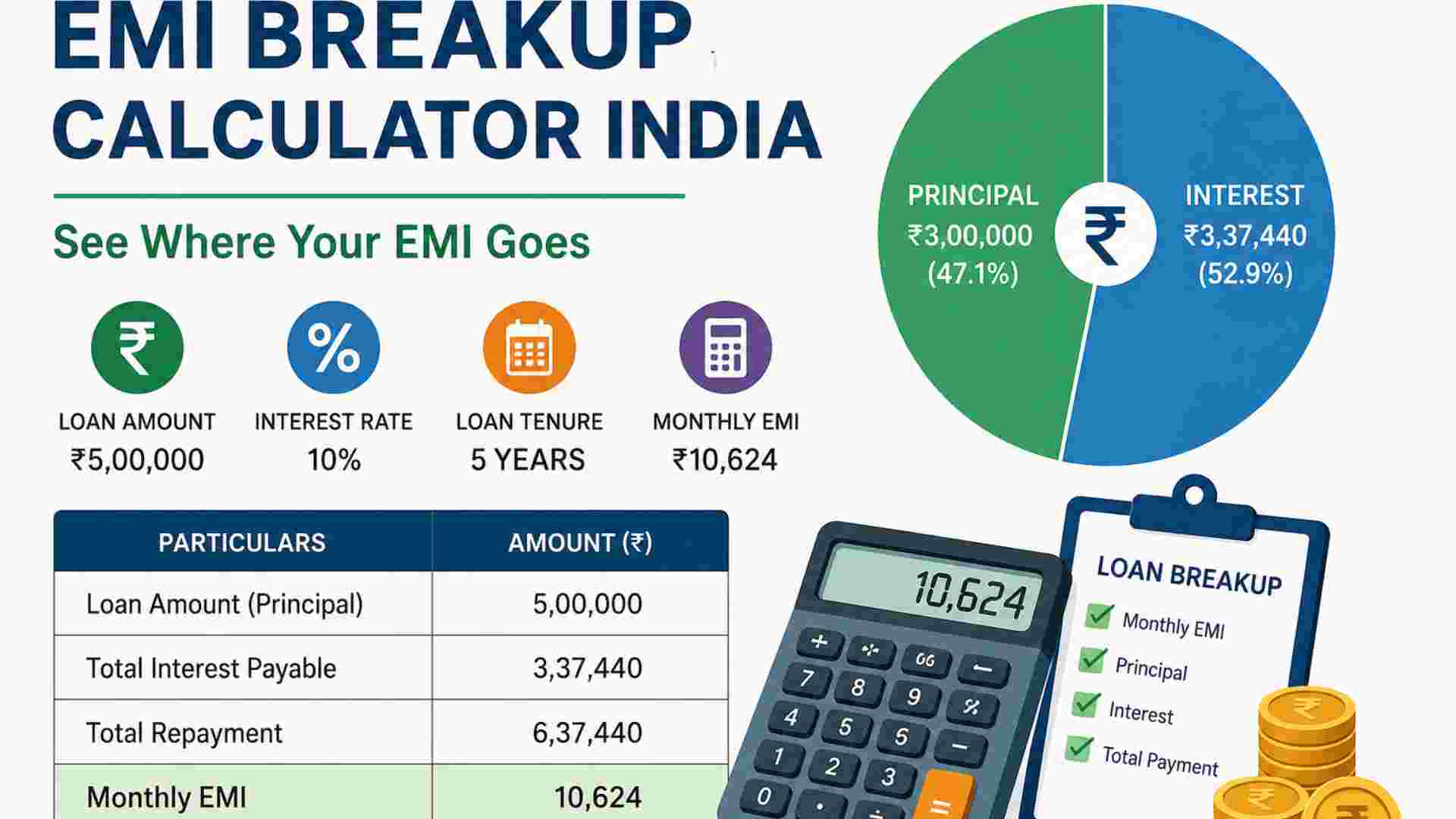
Our EMI breakup calculator takes your loan amount, interest rate, and tenure, and builds out a full month-by-month table. Every row shows your EMI, split cleanly into the interest portion and the principal portion, along with your remaining balance after that payment.
You don’t need to do any of the math yourself. Just enter your numbers, and scroll through the table to see your own loan’s actual story, instead of a rough guess based on your monthly statement alone.
What Is an EMI Breakup?
Your EMI, or equated monthly installment, stays the same amount every month for the life of your loan. That part everyone already knows. What most people don’t realize is that the same fixed EMI is made up of two very different pieces, and that mix shifts every single month.
In month one, a large chunk of your EMI goes toward interest. Only a small sliver actually reduces what you owe. As the months and years go by, that ratio gradually flips. By the final years of your loan, almost your entire EMI is chipping away at the principal, with barely any interest attached.
This is called amortization, and it’s not a bank trick or a hidden fee. It’s simple math. Interest is calculated on your outstanding balance, and your balance is highest right at the start of the loan. As it shrinks, the interest portion shrinks with it, and the principal portion grows to fill the gap, since your EMI itself never changes.
Principal Versus Interest — Why the Difference Matters
Your principal is the actual amount you borrowed. Every rupee that goes toward principal is a rupee you’ll never have to pay interest on again. This is the part that genuinely builds your equity, whether that’s in a home, a car, or whatever you financed.
Your interest is simply the cost of borrowing. It doesn’t reduce what you owe at all. It’s the price the lender charges for letting you use their money now instead of saving up for years first.
Here’s why this distinction actually matters in real life. If you’re thinking about prepaying part of your loan, doing it early hits the interest-heavy years, which means you save a lot more than prepaying the same amount later, when your EMI is mostly principal anyway. An EMI breakup calculator is the easiest way to see exactly where you are in that curve right now, and how much a prepayment today would actually save you.
Example Calculation
Let’s use real numbers. Say you take a home loan of ₹30 lakh, at 9 percent annual interest, for 20 years. Your EMI comes out to roughly ₹26,992 a month, and it stays exactly that amount for all 240 months.
In month one, interest on ₹30 lakh at 9 percent works out to about ₹22,500. That leaves only around ₹4,492 of your EMI actually going toward principal. Out of nearly ₹27,000 paid, over 83 percent of it was just the cost of borrowing.
Now jump ahead to year 10, roughly the halfway point. Your outstanding balance has dropped, so the interest portion of your EMI has dropped too, down to around ₹15,800. The principal portion has grown to about ₹11,200. Better, but interest is still winning.
Fast forward to year 19, near the end. Interest has shrunk to just a few hundred rupees a month. Almost the entire ₹26,992 EMI is now going straight toward principal. Same EMI amount every single month of the loan, completely different story behind it depending on where you are in the timeline.
Seeing this laid out as an actual table, rather than three isolated numbers I just described, is exactly what an EMI breakup calculator gives you. It’s a genuinely different experience seeing your own loan’s shape instead of reading someone else’s example.
How to Use the Calculator
This takes about two minutes, and it’s worth doing properly rather than rushing through it.
Step 1 — Enter your loan amount. Use the actual amount you borrowed or plan to borrow, not the total cost of whatever you’re financing.
Step 2 — Enter your interest rate. Use the exact rate your lender quoted. Even a small difference here shifts the entire breakup table, so don’t round it off casually.
Step 3 — Enter your tenure. Whatever your loan term is, in years or months, depending on what the calculator asks for.
Step 4 — Review your EMI. This confirms the calculator has your inputs right before you dig into the breakup itself.
Step 5 — Scroll through the monthly breakup table. Look specifically at how the interest and principal columns shift over time. This is the part most calculators skip, and it’s genuinely the most useful part.
Step 6 — Find your current position, if you’re mid-loan already. Jump to whichever month matches how far along you actually are. That row tells you exactly what’s happening with your money right now, today, not just in some generic example.
Step 7 — Use this to decide on prepayment timing. If you’re still in the interest-heavy early years, this is exactly when a prepayment does the most good. The calculator makes that timing obvious instead of leaving it as a vague hunch.
Why Prepaying Early Matters So Much
I mentioned this above, but it deserves its own space because it’s genuinely the most actionable insight an EMI breakup gives you. Every rupee you prepay reduces your outstanding balance immediately. Since interest is calculated on that balance, a smaller balance means smaller interest charges for every single month that follows, all the way to the end of your loan.
Prepay ₹1 lakh in year one of a 20-year loan, and you save interest on that ₹1 lakh for nearly two decades. Prepay the same ₹1 lakh in year eighteen, and you’re only saving interest for two remaining years. Same amount of money, wildly different impact, purely based on timing.
This is exactly why financial advisors keep repeating the same advice about prepaying loans as early as possible. It’s not a generic platitude. It’s a direct, provable consequence of how amortization actually works, and an EMI breakup table makes that provable in front of your own eyes.
Common Misunderstandings About EMI Breakups
A lot of people assume their EMI itself changes over time, getting smaller as the loan matures. It doesn’t, at least not for a standard fixed-rate loan. The EMI amount is constant. What changes is only the invisible split happening underneath it.
Another common mix-up is assuming that after making, say, 50 percent of your total EMI payments, you’ve also paid off 50 percent of your principal. That’s almost never true. Because of how interest-heavy the early years are, you’ll typically still owe well over half your original loan amount even after making more than half your total payments, purely in terms of number of months.
People with floating-rate loans also sometimes forget that a rate change resets this entire breakup. According to the Reserve Bank of India, lenders are required to periodically reset floating rates against regulatory benchmarks, which means your interest-to-principal split can shift meaningfully whenever your rate moves, not just gradually over time as originally projected.
Using This for Loan Comparison Shopping
An EMI breakup calculator is also genuinely useful before you’ve even taken a loan, not just after. Comparing two lenders quoting slightly different rates? Run the same loan amount and tenure through both, and look past just the EMI number.
A lower rate doesn’t just mean a smaller EMI. It also means a healthier interest-to-principal ratio in those crucial early years, which translates to faster real progress on your loan, not just a smaller number on your monthly statement. Comparison platforms like BankBazaar can help you find current rates across multiple lenders, which pairs well with running each of those rates through your own breakup calculator before deciding.
A Few Honest Caveats
An EMI breakup calculator assumes a fixed interest rate for the entire tenure, unless it specifically supports rate-change modeling. If you have a floating-rate loan, treat the initial table as a snapshot based on today’s rate, not a permanent forecast, since your actual breakup will shift whenever your bank adjusts your rate.
It also doesn’t include processing fees, prepayment charges, or insurance add-ons some lenders bundle into a loan. Those affect your total cost, but they sit outside the core EMI breakup itself, so check your loan agreement separately for those numbers.
Even with those caveats, seeing your actual month-by-month split is worth far more than guessing. Run your loan through the EMI breakup calculator above, and you’ll understand your own loan better than most people ever bother to.
Related Calculators
If you found this useful, a few of our other calculators pair naturally with it, depending on what you’re actually trying to plan.
Want the bigger picture beyond just the breakup? The Loan Calculator gives you the full amortization schedule alongside prepayment scenario testing.
Specifically financing a home? The Mortgage Calculator is built around home loan EMIs, down payments, and tenure trade-offs.
Wondering what your money could do if invested instead of spent on prepayment? The Investment Calculator shows how a lump sum or SIP grows over time for comparison.
Curious how compounding works in your favor instead of against you? The Compound Interest Calculator shows the same math from the saver’s side of the table.
Planning further ahead? The Retirement Calculator helps you see whether you’re actually on track for the retirement you’re picturing.
Frequently Asked Questions
Why is most of my early EMI interest instead of principal?
Interest is calculated on your outstanding loan balance, which is highest right at the start. As you pay down the principal over time, the balance shrinks, so the interest portion shrinks too, and the principal portion of your fixed EMI grows to fill the gap.
Does my EMI amount change as the loan matures?
No, not for a standard fixed-rate loan. Your EMI stays the same every month for the full tenure. Only the internal split between interest and principal changes underneath that fixed number.
When is the best time to make a loan prepayment?
As early as possible in your loan tenure. Prepaying during the interest-heavy early years saves you interest for the maximum number of remaining months, which has a much bigger impact than prepaying the same amount closer to the end of your loan.
Does a floating interest rate affect my EMI breakup?
Yes. Whenever your floating rate changes, your interest-to-principal split resets based on the new rate and your current outstanding balance. It’s worth rerunning your EMI breakup calculator after any rate change your lender notifies you about.