Credit Utilization Calculator: What’s Your Real Credit Usage Ratio?
Quick question: do you know your credit utilization off the top of your head? Most people don’t, and that’s honestly a little wild, because it’s one of the only numbers on your credit report you can change in a matter of weeks, not years. Grab your last statement and let’s actually work this out.
Okay, but what is it, really?
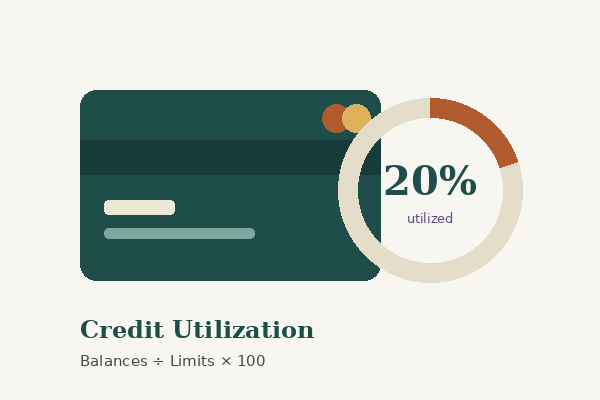
Strip away the jargon and it’s just a comparison: what you owe on your cards right now, stacked against what you’re allowed to borrow in total. Owe $2,000 with $10,000 worth of combined limits, and you’re at 20%. No trick to it.
Simple as the math is, this ratio ends up carrying a surprising amount of weight when a score gets calculated — usually trailing only your payment history in terms of influence.
Why does one percentage get this much attention?
Paying bills on time proves you’re dependable. Utilization tells a different story — how stretched thin you are right this moment. Someone running their cards up near 90% just reads as riskier to a lender than someone sitting at 8%, even if neither has ever missed a payment.
A handful of reasons this number pulls so much weight:
- It’s one of the biggest single factors baked into most scoring models.
- Your issuer reports it monthly, so it’s rarely a stale figure.
- It gets judged two ways — overall and card-by-card — which trips people up more than you’d think.
- It can swing hard in either direction within a single cycle, unlike almost everything else on your report.
Doing the math by hand
A calculator spits this out in a second, but it’s worth knowing what it’s doing behind the curtain.
Step one: total up what you owe
Every revolving account counts here — credit cards, store cards, lines of credit. Leave your car loan, mortgage, or student loans out of it entirely; installment debt has nothing to do with this ratio.
Step two: total up what you’re allowed to borrow
Same set of accounts, just adding up the limits instead of the balances this time.
Step three: divide, then turn it into a percentage
Balance total over limit total, multiplied by 100. That’s your number.
| Card | Balance | Limit |
|---|---|---|
| Card A | $800 | $5,000 |
| Card B | $1,200 | $3,000 |
| Card C | $0 | $2,000 |
| Total | $2,000 | $10,000 |
$2,000 divided by $10,000 comes out to 0.20 — multiply by 100 and this household lands at a tidy 20%.
So what number should you actually be aiming for?
Nobody’s carved an official rule into stone, but lenders and the major scoring models tend to land in roughly the same place. Here’s the general shape of it:
Here’s the part that surprises people: a flat 0% isn’t necessarily the goal either. Carrying a small reported balance — say, somewhere in that 1% to 9% window — often scores just as well as $0, sometimes better, since it actually shows you’re using credit rather than letting it sit untouched.
The trap almost nobody sees coming
This is where a lot of otherwise careful people get caught out. Your overall utilization blends every card into one number, but scoring models also size up each card individually. That means your combined ratio can look perfectly fine while one specific card is nearly tapped out — and that one card alone can still knock your score down.
Picture two cards, each with a $5,000 limit. Card A is sitting at $4,800 — 96% used. Card B hasn’t touched a dime. Blend the two together and you get a moderate-looking 48% overall. But Card A on its own is still flashing a warning sign, average or not.
Lesson learned: spreading spending across a few cards instead of leaning on one tends to work in your favor, even when the totals would technically even out either way.
Ready to actually bring it down? Here’s what works
Pay before the statement closes, not just before it’s due
Most people plan around the due date, but issuers typically report your balance on the statement closing date — which lands earlier in the cycle. Knock the balance down before that date hits, and a lower number gets reported, even if your actual due date is still weeks off.
Split it into two or three smaller payments
You’re not changing what you spend, just when you pay it. A couple of smaller payments through the month keeps whatever gets reported lower than one big payment at the end.
Just ask for a higher limit
Keep spending flat and raise your limit, and your ratio drops on its own. Heads up though — some issuers pull a hard inquiry for this, which can dip your score slightly and briefly. Usually worth it for what you get in return.
Stop leaning on the same card every time
Shift some spending toward whichever card has more room left, instead of defaulting to the one you always reach for.
Think twice before closing an old card
Closing an account shrinks your total available credit, which can bump your ratio up even if you haven’t spent a cent differently. Unless it’s costing you an annual fee, an old card sitting unused is usually doing you more good open than closed.
Set a balance alert now, before you need one
Most banking apps will ping you once a balance crosses a certain percentage. It’s a five-minute setup that catches a creeping balance long before it turns into an actual problem.
Where utilization fits next to everything else on your report
| Factor | What it reflects | How fast it moves |
|---|---|---|
| Payment History | Whether you pay on time | Slow — months to years |
| Credit Utilization | How much available credit you’re using | Fast — one billing cycle |
| Length of Credit History | How long accounts have been open | Very slow — grows with time only |
| Credit Mix | Variety of account types | Slow — changes with new accounts |
| New Credit Inquiries | Recent credit applications | Moderate — fades in 12–24 months |
Notice how everything else on that list takes real time to shift. Utilization is the exception — it can move before your next statement even arrives. That’s exactly why it’s worth focusing on first if you’re trying to clean things up before a mortgage or car loan application.
Questions people actually ask
What’s considered a good credit utilization ratio?
Under 30% is generally fine, under 10% is considered excellent, and a small single-digit balance often outperforms a flat $0 across every card.
Does checking my own utilization hurt my score?
Not at all. Looking up your own balances and limits is a soft inquiry, and soft inquiries never touch your score.
Should I pay every card down to exactly $0 each month?
You don’t have to. Paying in full avoids interest, which is great, but a small reported balance under 10% usually scores just as well as $0 — sometimes better, since it shows real, ongoing use.
How often does my utilization actually get recalculated?
Roughly once a billing cycle, whenever your issuer reports your balance — typically around the statement closing date, not the due date.
Do mortgages or car loans factor into this at all?
Nope. Only revolving credit — cards and lines of credit — counts here. Installment loans sit completely outside this calculation.
Could asking for a higher limit actually backfire?
It might cause a small, short-lived dip if your issuer runs a hard inquiry, but the long-term drop in your utilization ratio usually makes that trade-off worth it.
What’s the real difference between overall and per-card utilization?
Overall combines every card into one figure. Per-card looks at each one on its own. Both get evaluated separately, so a single maxed-out card can still hurt you even when your blended average looks reasonable.
Give it two minutes every so often and actually run your numbers — it’s one of the rare places on your credit report that rewards you almost as fast as you pay attention to it.