Loan Amortization Explained: A Simple Guide to Understanding Your Loan Payments
If you’ve ever taken out a mortgage, a car loan, or a personal loan, you’ve probably run into the word “amortization” somewhere in the paperwork. It sounds like something only an accountant would care about, but the idea behind it is actually pretty straightforward — and understanding it can save you real money.
What loan amortization actually means
Loan amortization is just the process of paying off a loan through fixed monthly payments over a set period of time. Each payment you make is split into two pieces:
- Principal — the actual amount you borrowed
- Interest — what the lender charges you for borrowing it
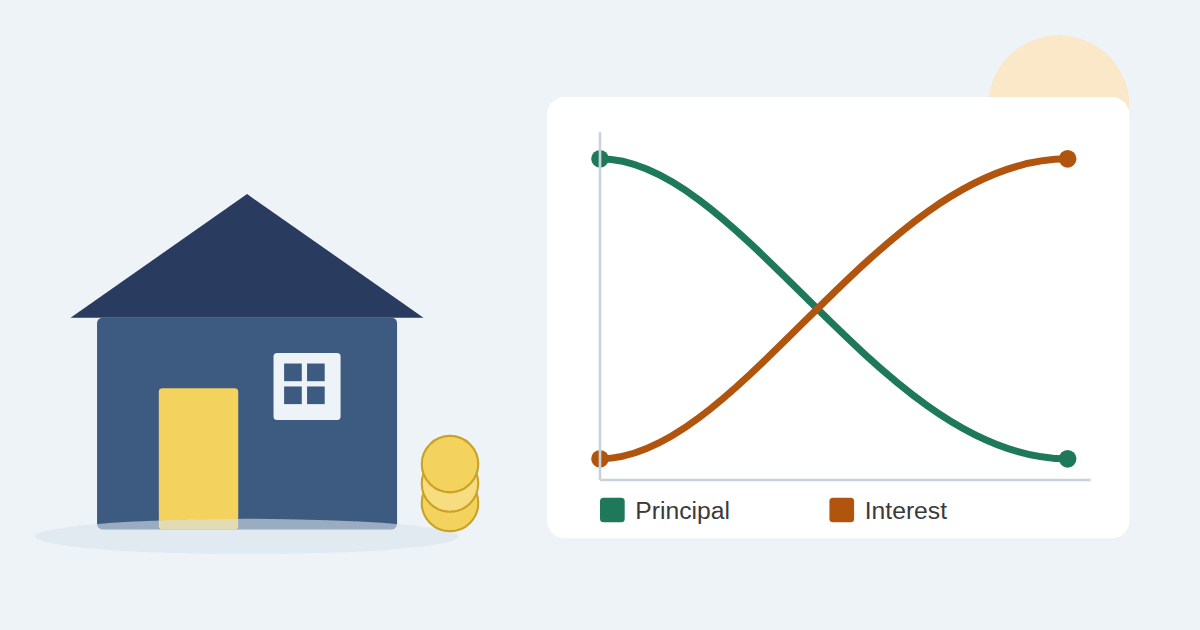
Here’s the part that surprises a lot of people: in the early years of a loan, most of your payment is going toward interest, not principal. Then, gradually, that balance flips — more of each payment starts chipping away at what you actually owe, and less goes to the lender’s cut. That slow shift from “mostly interest” to “mostly principal” is the whole mechanism behind amortization.
How it plays out in practice
Say you borrow $200,000 for a house at 6% interest over 30 years. Your monthly payment barely changes over three decades — but what that payment is made of changes a lot.
- Early on: roughly $200 goes to principal, $1,000 to interest
- A few years in: around $450 to principal, $750 to interest
- Near the end: about $1,050 to principal, only $150 to interest
Same monthly bill, very different breakdown. As your balance shrinks, the lender has less to charge interest on, so more of your money finally starts working for you instead of the bank.
The amortization schedule
An amortization schedule is simply a table laying out every single payment for the life of the loan — usually showing the payment number, the date, how much goes to principal, how much goes to interest, and what balance is left afterward. It’s not exciting reading, but it’s genuinely useful: it shows you exactly where your money is going, month by month, for the entire loan.
Why any of this matters
Once you can actually see how a loan is structured, a few things get a lot easier:
- Budgeting, since you know what’s coming every month
- Understanding the real cost of the loan, not just the sticker payment
- Comparing offers from different lenders on equal footing
- Deciding whether it’s worth throwing extra money at the balance
- Keeping tabs on how much you still owe
None of that requires a finance degree — just a look at the schedule.
The math behind it (if you’re curious)
The formula lenders use to calculate a fixed monthly payment is:
M = P × [r(1+r)n] / [(1+r)n − 1]
Where M is the monthly payment, P is the loan amount, r is the monthly interest rate, and n is the total number of payments.
Honestly, almost nobody does this by hand anymore — a free online amortization calculator will spit out the same answer in seconds. But it’s worth knowing the formula exists, if only to understand what’s driving the number the calculator gives you.
A worked example
Let’s say you take out $25,000 at 8% interest over 5 years. Here’s how a handful of those 60 payments would break down:
| Month | Principal | Interest | Remaining Balance |
|---|---|---|---|
| 1 | $339 | $167 | $24,661 |
| 12 | $362 | $144 | $20,542 |
| 24 | $392 | $114 | $15,903 |
| 36 | $424 | $82 | $10,820 |
| 48 | $459 | $47 | $5,210 |
| 60 | $503 | $3 | $0 |
Notice the pattern — the interest column keeps shrinking while the principal column keeps growing, even though the total payment barely moves.
Where you’ll run into amortization
Most fixed-rate loans work this way, including:
- Mortgages and home loans
- Personal loans
- Auto loans
- Student loans
- Business loans
If your interest rate is fixed and your payment doesn’t change month to month, there’s a very good chance it’s amortized.
Why it’s worth understanding
Predictability. Your payment is the same every month, which makes budgeting much less of a guessing game.
A clear finish line. You know, to the month, when the loan will be paid off — assuming you stick to the schedule.
Transparency. You can see, at any point, exactly how much of your money has gone to interest versus how much has actually reduced your debt.
Better planning. Because the schedule is predictable, you can project your balance months or years into the future.
Can you pay it off early?
Yes — and it’s often worth doing. Making extra principal payments can:
- Cut down the total interest you’ll pay over the life of the loan
- Shorten how long you’re in debt
- Build equity faster if it’s a home loan
Even one extra payment a year can shave a surprising amount off both the timeline and the total interest, because you’re reducing the balance that future interest gets calculated on.
Amortization vs. simple interest
| Amortized Loan | Simple Interest Loan |
|---|---|
| Fixed monthly payments | Interest calculated only on the outstanding principal |
| Each payment covers both principal and interest | Often fewer, less structured payments |
| Typical for mortgages and personal loans | More common for short-term loans |
Mistakes people tend to make
A lot of borrowers focus so much on “can I afford the monthly payment” that they lose sight of the bigger picture. Common slip-ups include:
- Ignoring the total interest cost over the life of the loan
- Picking a longer term just because it lowers the monthly payment, without comparing the full cost
- Never actually looking at the amortization schedule
- Forgetting that even small extra payments add up
Avoiding these can genuinely save thousands of dollars, especially on a mortgage.
A few ways to cut down on interest
- Choose the shortest term you can comfortably afford
- Make extra principal payments whenever you have room in your budget
- Refinance if a meaningfully lower rate becomes available
- Avoid late fees, which just add cost on top of cost
- Check your amortization schedule now and then to see where you actually stand
Frequently asked questions
What is loan amortization?
It’s the process of paying off a loan through regular payments that cover both principal and interest, spread out over a fixed period.
Does every loan have an amortization schedule?
No. Most fixed-rate loans do, but some loans — interest-only loans, for example — follow different repayment structures.
Can I make extra payments?
Yes, and it’s usually a good idea. Extra payments typically go straight to reducing your principal, which lowers the total interest you’ll pay.
Why do I pay more interest at the start?
Because interest is calculated on whatever balance is currently outstanding, and that balance is at its highest right at the beginning of the loan.
Are online amortization calculators accurate?
Generally, yes — a good calculator will give you a reliable estimate based on the loan amount, interest rate, and term you enter.
The bottom line
Loan amortization sounds more complicated than it is. At its core, it’s just a structured way of paying down a loan over time, with the split between interest and principal shifting gradually as you go. Once you understand that, you’re in a much better position to compare loan offers, budget realistically, and decide whether paying extra now is worth it later.
Whether you’re buying a house, financing a car, or taking out a personal loan, pulling up the amortization schedule before you sign anything is one of the simplest things you can do to stay in control of the cost.
https://epictravelnotes.com/loan-amortization/